


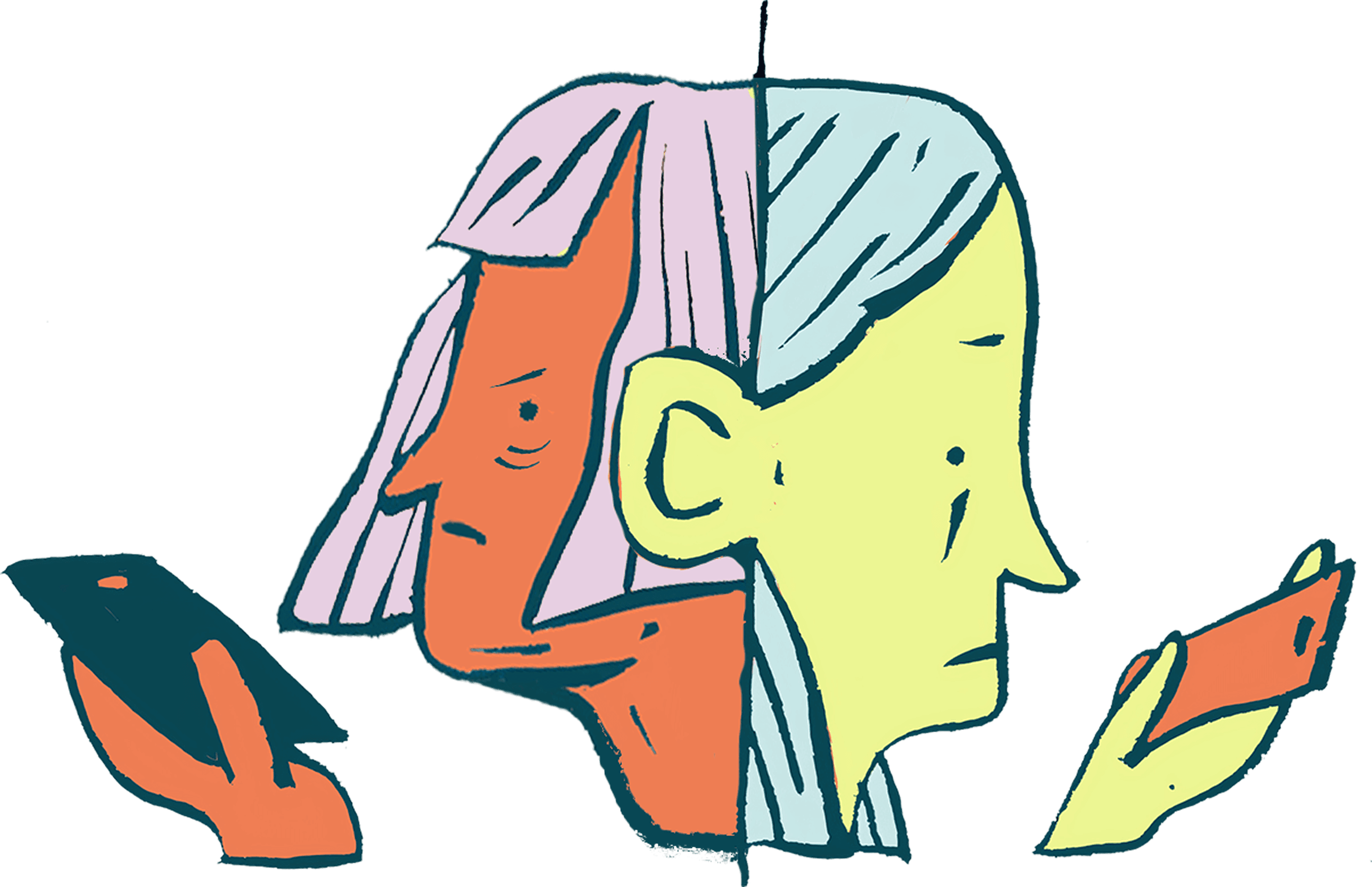
When your mother is toxic and hurtful: How to communicate with her and set boundaries
I sacrificed everything for you, and you can't even call? Oh come on, you're remembering it wrong again. Right, I'm just the worst mother in the world...
Did you feel a pang of recognition reading those words? Even though it's rarely talked about, family situations like these are far from unusual. Almost half of us carry pain from childhood that has shaped our relationship with our parents.
So you may find yourself avoiding them, consciously or not. But then come the accusations that you're a bad daughter or son. You're afraid to talk about your feelings in case the people around you judge you as ungrateful.
Let's look at the topic of "toxic parents" through a psychological lens. We'll show you how to handle the situation while protecting your mental health.
A bad relationship with your parents is not your failure
It's natural to look for fault in yourself. Am I really remembering this right? What if it's my fault? We hear it from all sides: that we owe our parents gratitude and respect.
Respect for parents is of course important, just as it is for anyone. Blind admiration is something else entirely, though. Nobody is owed that simply for putting a roof over your head. That is a basic duty, not a bonus.
It was your parents who held responsibility for the relationship when you were a child. They were the adults. Children are vulnerable, dependent on their caregivers, and their brains are still developing.

That doesn't mean a difficult relationship with your mother is black and white
Parents are only human, of course. They make mistakes and carry their own traumas. As adults, we also take on our share of responsibility in relationships.
But if you have long felt unloved and unheard, and your attempts at communication have been met with mockery or silence, that's no longer an occasional slip-up. It's a pattern. You have every right to feel pain, anger, and bitterness.
You can still love them and understand why they behave the way they do. But it is completely okay to protect yourself in the process. Setting boundaries isn't ingratitude; it's healthy self-defence.
How a toxic family can affect our lives
We carry more from childhood into adulthood than we might realise. When we look at the most common mental health struggles, their roots often trace back to family relationships.
- We may struggle with low self-confidence if our parents constantly compared us to others or criticised us.
- We often can't say no and try to please everyone, if we had to earn love as children.
- We may develop an anxious or avoidant attachment style that makes it hard to maintain healthy relationships.
- We experience chronic stress, anxiety, or depression.
That makes it all the more important to be kind to yourself, stop the self-blame, and give yourself the space to heal.
Test: is your mother really toxic?
Every mum loses her cool occasionally or says something she shouldn't. Toxic behaviour starts when the exception becomes the rule, "sorry" is nowhere to be found, and the guilt always ends up with you.
It's worth noting that "toxic" is not a clinical psychological term. It has no fixed definition. Let's look at how to recognise problematic behaviour, though - because with parents, we often end up blaming ourselves.
We'll walk through three types of mothers who don't create emotional safety in their relationship with their children, and who could therefore be described as toxic. But don't just count how many "yes" answers you give. The pattern matters more than the number. Ask yourself: are these one-off situations, or a recurring way she treats me? The more questions describe something you experience regularly and over a long period, the stronger the signal.
The emotionally unavailable mother
The core feeling she leaves you with: She looked after me, but she was never really there for me. You grew up feeling that your emotions were a burden, or simply not worth paying attention to.
- You always had warm dinners, toys, and after-school activities, but were missing ordinary hugs, affection, or the words I love you?
- Did she often dismiss your feelings with things like Stop crying, it's nothing?
- Did you have to "earn" love and affection, through good grades at school or, later on, career achievements?
- Is it hard for her to talk about feelings, and does she always steer the conversation towards practical matters?
- Was she physically present, but you had the sense that her thoughts and attention were always somewhere else?
The manipulative mother
The core feeling she leaves you with: I have to walk on eggshells and I never know where I stand. Her tools are guilt, fear, and undermining your perception of reality.
- Do you often hear things like: After everything I've done for you. If you do that, you'll ruin my life. If you cared about me, you wouldn't act like this?
- Does she deny your feelings and insist that nothing ever happened, or that you're just misremembering?
- Does she have no concept of privacy, interfering in your relationships or reading your messages?
- When you try to open up to her, does she turn it around so that you end up comforting her?
- Do you feel like you have to watch your every word around her?
- Does she disguise crossing boundaries as maternal love? For example: I only want what's best for you. You're making a drama out of nothing, as usual.
The narcissistic mother
The core feeling she leaves you with: I exist mainly as an extension of her personality, not as my own person. Manipulation is just one of her tools. At the core, everything revolves around her.
- When you come to her with a problem or a piece of good news, does she quickly redirect the conversation back to herself?
- Does she take credit for your successes (She gets that from me, I raised her so well!), but get angry when things go wrong because you're making her look bad?
- Does she care a great deal about what other people think, and want to look good in their eyes?
- Does it feel like no matter how hard you try, you'll never be good enough?
- Does your mother treat every small thing as a personal attack?
- Does she behave completely differently in public than she does in private?
All three types of behaviour have toxic traits. If you answered yes to several questions across them, that's natural. These patterns very often overlap.
Yes answers don't necessarily mean your mother doesn't love you, though. She may have unresolved issues of her own that she doesn't know how to handle. What matters is how you feel in the relationship and how it affects your mental health.

Mother-daughter vs. mother-son relationships: the differences might surprise you
Toxic behaviour hurts every child equally, whether they're a daughter or a son. The way you experience it can sometimes feel a little different, though.
- With a daughter, a mother often competes, compares herself, and treats her as a second chance at her own life. Arguments may centre on appearance, weight, or life choices. She frequently tries to provoke guilt, punishes with the silent treatment, or fails to respect your privacy.
- With a son, the dynamic tends to be a little different. A mother may see him as a substitute partner, spoiling him and preventing him from growing up. She may be jealous of his partners and insist that no one is good enough for him. If he tries to set boundaries, she often reacts with distress and hurt feelings.
These patterns are very common, but they certainly don't apply to everyone. People are different, and gender doesn't have to define us.
How to survive a toxic mother, communicate with her, and still protect yourself
Cutting ties with family is never easy, even when they have hurt you deeply. If you're not ready for that, that's completely okay. Let's look at how to communicate with a toxic mother without losing yourself in the process.
- Try to adjust your expectations. You probably won't change your mother, and she will never be the perfect mum you always wished for. It is a deeply painful but liberating step. Try to accept her as she is, with all her very real limitations.
- Allow yourself to grieve. Letting go of the hope for a perfect family is hard. You don't have to pretend everything is fine. Cry, shout, talk it through. It will bring relief.
- Limit how much personal information you share. If your mother regularly turns things against you, don't give her ammunition. Stick to safe topics like the weather, films, or food. Save your emotions for people you feel safe with.
- If she tries to provoke you, use the "grey rock" technique. A manipulator wants to trigger anger or tears. Try to mute your emotional response and keep your replies brief. For example: Hmm, maybe. Right. I'm sorry you see it that way.
- Set clear rules and consequences. If your mother regularly crosses boundaries, state a consequence clearly: If you don't stop shouting at me, I'm going to have to hang up/leave. Then actually follow through, without further explanations or apologies.
- Don't defend yourself or argue. Try simply stating your decision and sticking to it. Repeat one statement on a loop: I've made up my mind and I'm not going to discuss it further. I'm sorry you see it that way, but my decision stands. I understand you're disappointed, but that's how it's going to be.
- Build a "chosen family" and invest in those relationships. You don't have to share DNA with people for them to be your closest and most loved ones. Your family can be friends, colleagues, a partner, or their family. Anyone who makes you feel good and safe.

Do you still feel afraid of your parents as an adult? Where toxic behaviour ends and psychological abuse begins
A difficult relationship with family is genuinely hard. Most of the time, though, we can still function normally, live our lives, and occasionally call our parents, even if it costs us something each time.
Sometimes, though, there's something more: constant fear and a sense of threat, severe anxiety, or panic attacks. This can be an early sign of psychological abuse.
Perhaps your parents lie and distort reality on more serious matters, speak badly of your partner, or use emotional manipulation. Every contact escalates into an argument, no matter how hard you tried to avoid it.
In situations like these, it is very hard to make sense of what's happening or know how to respond. Your own mental health must come first, though. Talk to a psychotherapist who can help you work through the situation.
When is it time to cut ties completely?
If it takes you days to recover after contact with your family, you're experiencing chronic stress or anxiety, your parents are using emotional manipulation, or they are even physically threatening you, it's time to leave. Cutting off a family like this is not ingratitude. It is a necessity and an act of self-preservation. It is not your fault, and you have not failed.
You don't have to face a painful family relationship alone
Don't be afraid to ask for help. Therapy is remarkably effective when it comes to toxic family dynamics. It can help you leave a difficult childhood behind and stop letting your past shape your present.
At Hedepy, among more than 160 verified psychotherapists, you'll find the right fit. To make it easier, we'll recommend the most suitable therapist for you based on a 5-minute matching test. You could have your first session within just a few days.
Thinking about therapy?
My First Therapy: How to Prepare and What to Expect
What is psychotherapy? And who is it for?
Does online therapy really work? Isn't face-to-face better?
Explore options


