


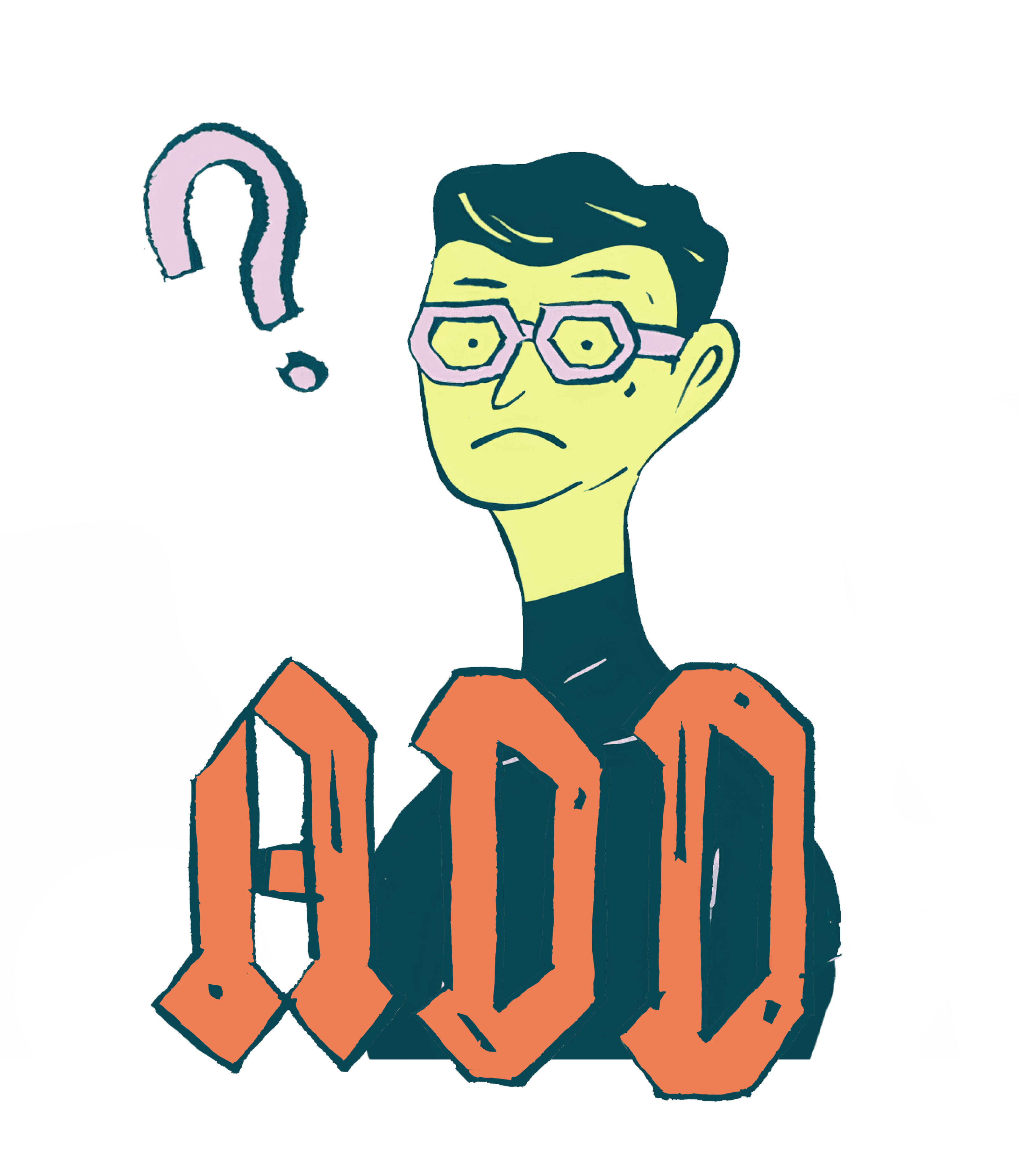
ADD: attention deficit disorder without hyperactivity. What are the symptoms and what can you do?
You meant to tidy up, but you came across an old diary and an hour later realised you'd completely forgotten about the tidying. Then you turned up late to meet a friend again, even though you really tried to make it on time. Or maybe it's your child, whose mind always seems to be somewhere else.
Do you often find yourself in situations like these? You might sometimes put it down to laziness or incompetence. In reality, though, it could be ADD, or attention deficit disorder without hyperactivity.
You can't diagnose it yourself at home, but a scattered mind can be the first sign that this topic is worth exploring. We'll show you how to recognise ADD, what it actually means for you and what you can do next so that you or your child can feel better.
What is ADD?
ADD is a congenital attention disorder, just like ADHD. You've certainly heard a lot about ADHD already, but maybe you feel you don't quite recognise yourself in that diagnosis. After all, as a child you didn't run around the classroom or interrupt others. You were more likely to sit quietly and stare out of the window.
ADD refers to attention deficit disorder without hyperactivity (short for Attention Deficit Disorder). It describes exactly the kind of difficulties where it's hard for you to keep your attention, focus, plan or filter out distractions, but there's none of the outward restlessness and impulsivity that we typically associate with ADHD.
However, ADD is no longer a separate diagnosis today. Medicine used to distinguish between ADD and ADHD, but professionally we now only talk about ADHD, which has several types. In professional terms, ADD is now referred to as ADHD with predominantly inattentive presentation (inattentive type).
So if you've ever thought "I don't have ADHD because I've never been hyperactive", here's the explanation. Hyperactivity is just one of its possible faces, not a requirement. All that chaos can take place mainly on the inside, in your head.
We look at the differences between the two terms in more detail in our article ADD vs. ADHD. In everyday language, however, the term ADD is still widely used, and we'll stick with it in this article too, to make the distinction easier.
What happens in the brain with ADD?
The brains of people with ADD work a little differently from most others. The main difference lies in how they handle the neurotransmitters dopamine and noradrenaline. These are essential for the brain's executive functions.
They help us start a task, keep our attention on it, plan, resist distractions and remember what we're doing. When the dopamine and noradrenaline signal is weaker, executive functions have nothing to draw on. And that's where all that familiar chaos comes from.
That's why advice like "you just need to concentrate more" or "you just have to want it" simply doesn't work. It's not about willpower or laziness. Keeping your attention is much harder for your system.
It also explains a paradox you probably know from your own life: you can stay focused for hours on things you enjoy. But with a boring task, you can't even bring yourself to start. Interest and novelty give the dopamine system a kick. But when they're missing, getting started is much harder.

How to recognise ADD in children?
Children with ADD are usually calm and don't draw attention to themselves. They often stare into space, live in their own world and don't take in what we say when we talk to them.
They're easily distracted by even the smallest stimulus, such as a bird outside the window or a noise in the hallway. They struggle to finish activities, often lose school supplies and toys or forget their homework. They may also have poorer motor skills, for example they may not like drawing and have messy handwriting. They're easily thrown off balance and react to pressure by crying, becoming anxious or withdrawing into themselves.
This is exactly why ADD in children often goes unnoticed. Children with ADD aren't "naughty", they're more likely to keep getting lost in their own thoughts.
Interestingly, the number of children with ADHD in the Czech Republic is growing rapidly overall. Cases rose by 14% in five years. Boys are affected three times more often than girls.
What are the symptoms of ADD in adults?
In adults, ADD often turns into extreme procrastination and poor time management. Adults are better at masking the symptoms on the outside, but the chaos in their head remains.
For example, you may constantly be late and miss deadlines, put off tasks or easily get bored with uninteresting work. You find it hard to figure out where to start, so you'd rather do nothing at all. When there's too much on your plate, you easily get overwhelmed and panic.
The biggest clue, however, isn't procrastination itself. It's rather the fact that you already experienced the symptoms in childhood. Because it's a congenital disorder, ADD never starts in adulthood.
The number of adults with ADHD in the Czech Republic is also growing. In 2010, around thirty thousand adults had been diagnosed with the disorder; fifteen years later, it was fifty thousand.
Try an indicative ADD test
You can get a quick first idea from an indicative questionnaire developed by the World Health Organization (WHO). However, there's no standardised questionnaire specifically for ADD, as it's now considered the inattentive type of ADHD.
Try the indicative ADHD test →
Treat it as an indicative aid only, not a diagnosis. Whether it really is ADD (i.e. a type of ADHD) can only be confirmed by a clinical psychologist or psychiatrist.

How is ADD diagnosed in children and adults?
There's currently no brain scan or blood test that can confirm ADD. Diagnosis is a process, but that's actually good news. It means someone will take a proper, in-depth look at you.
An ADD diagnosis usually includes:
- a diagnostic interview about how the difficulties show up today and how they showed up in childhood,
- self-assessment questionnaires and scales,
- neuropsychological tests of attention and memory
- and ruling out other causes such as fatigue, anxiety, depression, sleep problems or even thyroid problems. These can look similar.
ADD can be diagnosed by a clinical psychologist or psychiatrist
The psychologist will then recommend a treatment approach and usually refer you to other specialists (a psychiatrist, a psychotherapist or both). As a doctor, a psychiatrist can prescribe medication straight after the diagnosis if needed and often also recommends psychotherapy.
If all those psych professions confuse you, read our article Psychiatrist, psychologist, therapist: what is the difference between them and whom to go to? What's important to know is that if you want a diagnosis, you need to start with a clinical psychologist or psychiatrist.
At Hedepy, we have a team of board-certified doctors who offer online psychiatric assessments. You can get an appointment within two weeks.

ADD treatment: what helps?
Living with ADD unknowingly your whole life takes a lot out of you. Feelings that you "keep messing everything up" may surface and knock your self-confidence. On top of that, you're battling clutter in your head and on your desk.
Although ADD can't be cured like a cold (it's simply the way your brain works), it's possible to ease the symptoms very effectively and make your life easier.
ADD treatment usually includes:
- Psychotherapy, especially CBT. Cognitive behavioural therapy (CBT) is one of the best-proven methods for ADD. It helps you find a concrete system for starting tasks, planning and not getting overwhelmed, while also working through secondary effects, such as anxiety or a sense of failure, that have built up over the years.
- Adjusting your routine and environment. Fixed routines, breaking big tasks into smaller ones, a clearly organised workspace, alarms and reminders. On its own, this won't solve ADD, but it makes everyday functioning much easier. A psychotherapist will help you bring these changes into your life.
- Medication. According to studies, it can significantly reduce difficulties with concentration and sustaining attention. However, it's always prescribed by a psychiatrist and only after an assessment. It's a medical decision.
Experience so far shows that the best results come from a combination of psychotherapy and medication. However, only a doctor can recommend the right treatment for you. Far from everyone with an ADD or ADHD diagnosis needs medication.
Talk to a professional about your suspected ADD
You don't have to face it alone. At Hedepy, you can meet a psychotherapist or psychiatrist online from home, even within just a few days.
To make it easier for you, we've prepared a matching test: just answer a few simple questions and at the end you'll find out which of our more than 150 verified mental health professionals could be the best fit for you.
Thinking about therapy?
My First Therapy: How to Prepare and What to Expect
What is psychotherapy? And who is it for?
Does online therapy really work? Isn't face-to-face better?
Explore options


